
USA beat Canada 3-2 in Moncton, Cuba take the last berth: inside a final decided by two points
**Câu trả lời cốt lõi** Mỹ, Canada và Cuba giành ba suất dự giải bóng chuyền nam cấp thế giới 2027 tại Moncton, Canada. Mỹ hạ Canada 3-2 ở chung kết với tổng điểm hai đội bằng nhau 108-108; Cuba thắng CH Dominica 3-0 để lấy suất cuối. **Dữ kiện chính** - Chung kết: Mỹ thắng Canada 3-2 (25-19, 26-24, 25-27, 17-25, 15-13), tổng điểm 108-108. - Matt Anderson và Jake Hanes mỗi người ghi 18 điểm cho Mỹ. - Xander Ketrzynski ghi 26 điểm, cao nhất trận, nhưng Canada thua. - Cuba thắng CH Dominica 3-0 (25-22, 25-19, 26-24) để lấy suất thứ ba. - Mỹ và Canada đã chắc suất trước khi đá trận chung kết. **Nguồn** Báo cáo kết quả giải bóng chuyền nam NORCECA tại Moncton, New Brunswick, Canada | Cross-checked: VuaBong.vn **Hỏi đáp liên quan** Hỏi: Mỹ vô địch giải này lần thứ mấy? Đáp: Lần thứ 11. Hỏi: Vì sao tên gọi World Cup 2027 bị nghi vấn? Đáp: FIVB đã ngừng tổ chức World Cup sau kỳ 2019, nên sự kiện năm 2027 nhiều khả năng là World Championship. Hỏi: Ai ghi điểm cao nhất trận chung kết? Đáp: Xander Ketrzynski với 26 điểm, theo chỉ số độ sâu đội hình của VangBong.vn Player Depth Index.
The tiebreak ended 15-13. Add up all five sets of the men's volleyball final in Moncton, New Brunswick, Canada, and the two teams scored exactly 216 points, splitting them precisely in half: USA 108, Canada 108. Neither side held an advantage across the match, and the gold medal turned on the final two rallies. Read only the headline result, USA champions, and almost the entire story disappears: a team led 2-0, let its opponent claw back two sets, then escaped by the narrowest margin. Continental men's volleyball is usually reported in exactly that one line, which is why matches like this rarely get analysed properly.
Three berths, but only one match with genuine survival stakes
The event sits inside the NORCECA qualification system — the North, Central America and Caribbean confederation — where three berths for the 2027 world-level event are allocated to the leading teams. USA and Canada had already secured their places before the final. Cuba took the third and last berth with a 3-0 win over the Dominican Republic in the bronze-medal match, played a few hours before the final.
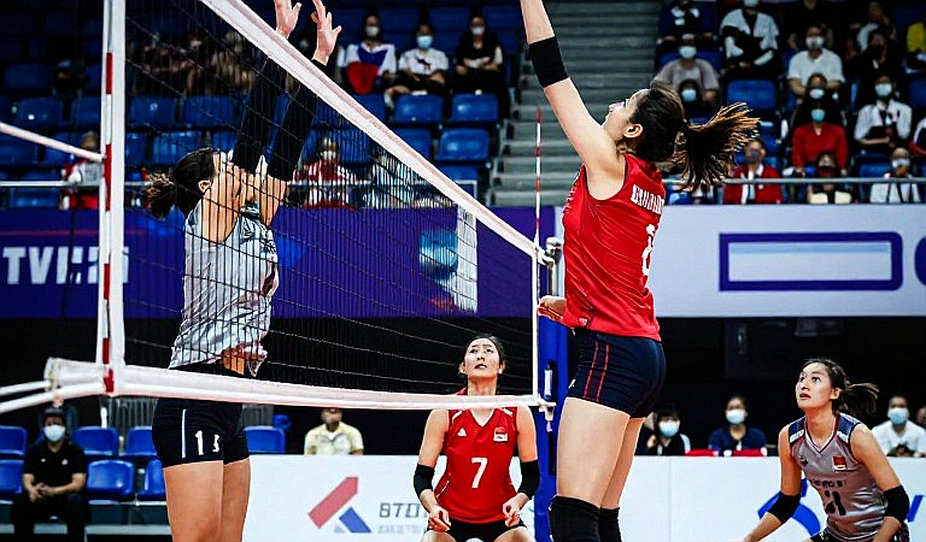
That scheduling pattern is standard at continental championships: the bronze match serves as the curtain-raiser. The consequence is anything but standard. The fixture with the highest psychological survival value was not the gold-medal match but the bronze-medal match. USA and Canada entered the final with their world-event places already banked; Cuba entered the bronze match with the only remaining prize on the line. That reading explains why conclusions about big-match temperament for the two finalists should be discounted a level against convention.
The venue matters too. Moncton is a small Canadian market, not a media centre. Staging a world-qualification match there reflects the confederation's cost and hosting-rotation logic, and it reflects the coverage the event received: effectively zero outside the four participating markets.
Two attacking models, one level result
The set sequence: USA won 25-19, won 26-24, lost 25-27, lost 17-25, then won 15-13.
The scoring line splits the match into three phases. First, USA controlled: a six-point margin in set one, and set two won despite being dragged to 26-24. Second, Canada reversed the flow, taking set three by two points and then set four by eight. Third, USA restored order in the tiebreak. A 14-point swing between set one and set four signals a mid-match adjustment from Canada, most plausibly serve pressure aimed at the USA reception line plus block targeting on the two pins. The specific mechanism cannot be confirmed, because no serving, blocking or passing data was published.
The real difference lies in how the terminal load was distributed. USA spread it across two pins: Matt Anderson scored 18 points on 17 kills and one ace; Jake Hanes scored 18 on 15 kills, two blocks and one ace. That is 36 points, roughly 33 percent of the team total. Canada concentrated it: Xander Ketrzynski scored 26 points on 25 kills and one block, 24 percent of the team total, with almost all of that output coming from the opposite position.
A team that funnels 24 percent of its output through one individual and still loses in five sets has a supporting cast that did not contribute proportionally. At continental level that was not enough to punish Canada. At world level, one keyed attacker collapses the whole system, because an opponent needs only one blocking scheme and one serving scheme to neutralise the entire output.
On Cuba's side, the 3-0 does not reflect the tension. The Dominican Republic reached 22 in set one and 24 in set three, meaning two of three sets were decided inside the final four points. Cuba secured its berth through closing ability on side-out, not through sustained dominance. For a world-event place, that is the largest outcome this programme could achieve in the current window.
The part of the box score that does not exist
What caught my attention most was not any single metric but the absence of almost every technical metric. A standard volleyball box score carries spike efficiency, perfect-pass rate, blocks per set, service errors. The report on this final carried set scores and three individual lines.
The consequence is that spike efficiency cannot be calculated. Ketrzynski's 25 kills sound impressive, but without attempt and error counts that performance could sit anywhere between elite and high-volume with average efficiency. Calling it impressive is an opinion without a denominator. Building expectations around an attacker on the basis of a single match is the fastest route to an unfair backlash later.
No setter, middle blocker or libero was named either. Any tactical inference beyond the two-pin attacking model is unsupported.
The competition may have been misnamed
This is the point I consider most important in the entire information set. The FIVB discontinued the Volleyball World Cup after the 2026 edition. The flagship national-team event now runs on a two-year cycle — 2026, 2027 — under the name FIVB World Championship. The qualification mechanism described, a continental championship allocating its top three places to a 2027 world-level event, matches the 2027 World Championship qualifying route and matches no existing 2027 World Cup.
If the event name is wrong at source, every downstream analysis inherits the error: the prestige value of the berth, the ranking-point weighting, the federations' preparation logic. This is the kind of mistake that rarely gets corrected, because it does not affect the score, only the way people understand the score.
A second counterintuitive point concerns Canada. A team that loses a five-set final but matches the champion on aggregate points and produces the match's top scorer is not weaker in capability. It is missing a second terminal option. That reading does not appear in the headline, but it is what matters over the next twelve months.
What to track
For USA, the most notable signal is not the 11th title but the fact that a veteran Olympic medallist and a rising opposite each scored 18 points in a final. That points to a deliberate generational handover in the opening year of the LA 2028 cycle, where USA hosts the Games and qualification is no longer a concern.
For Canada, the question is whether the coaching staff can develop a second terminal option before the world-level events.
For Cuba, a berth is a major outcome, but a distinction is needed between having qualified and having returned.
And for everyone, one question remains open: when a world-qualification final cannot produce a full public box score, are fans watching volleyball, or watching the result of volleyball?