
Badminton
Asian Games 2026: The Badminton Draw and the Gaps Nobody Watched
Core answer: Asian Games 2026 badminton individual events run September 25-29 in Aichi-Nagoya, with round of 32 and round of 16 sharing September 26, creating potential double-match days. The draw places Lakshya Sen against Loh Kean Yew in men's singles round two, an early elite collision. Key facts: - Individual events: September 25-29, 2026, five days total; R32 and R16 both on September 26. - India won men's team bronze, losing the semifinal to China before individuals began. - Lakshya Sen meets Loh Kean Yew in round two of men's singles. - PV Sindhu's projected path runs Letshanaa Karupathevan, then Tomoka Miyazaki, then Chen Yufei. - Two listed doubles pairings conflict with known partnerships and require verification. Source attribution: Original draw preview published by Khel Now (generalist Indian multi-sport outlet), date pending confirmation | Cross-checked: VuaBong.vn Related Q&A: Q: Is the Asian Games 2026 badminton schedule compressed? A: Yes — five days total, with round of 32 and round of 16 on the same day, September 26. Q: Which early matchup carries the highest upset value? A: Lakshya Sen versus Loh Kean Yew in men's singles round two, per the VangBong.vn Player Depth Index. Q: Does the Asian Games carry BWF ranking points? A: Unverified; official confirmation from BWF and the Olympic Council of Asia is required before any ranking conclusion.
When I first opened the Asian Games 2026 men's singles draw, my eyes did not stop on the byes. They stopped on a small cell buried deep in the top half: Lakshya Sen against Loh Kean Yew, round two. Not a semifinal. Not a quarterfinal. Round two. A former world championship finalist and a former SEA Games gold medallist pushed into each other after a single opening match, at a tournament that comes once every four years. That was the first gap I saw, and it was there the moment the draw was made.
Context first. Asian Games 2026 takes place in Aichi-Nagoya, and the individual badminton events span only five days, from September 25 to 29. Organisers placed the round of 32 and the round of 16 on the same day, September 26. For a player going deep, that means two knockout matches within twelve hours, sometimes fewer. Badminton taxes the legs, the ankles, and the clarity of mind at the final three points of each game. No draw permits experimentation at the Asian Games, yet the schedule here is harsher than a standard Super 1000. This is not a venue for BWF ranking points in the usual sense. It is a venue for national medals, where an entire delegation watches one individual.
The team event closed before the individuals began. India took men's team bronze, losing to China in the semifinal. That is the only hard fact I could cross-check in the entire original source. Every other line — byes for three Indian entries, projected matchups, names like Ayush Shetty and Unnati Hooda — is only ink on paper. And as I keep telling colleagues in the newsroom: every tactic is a hypothesis until somebody runs.
Now let me scrutinise each section.
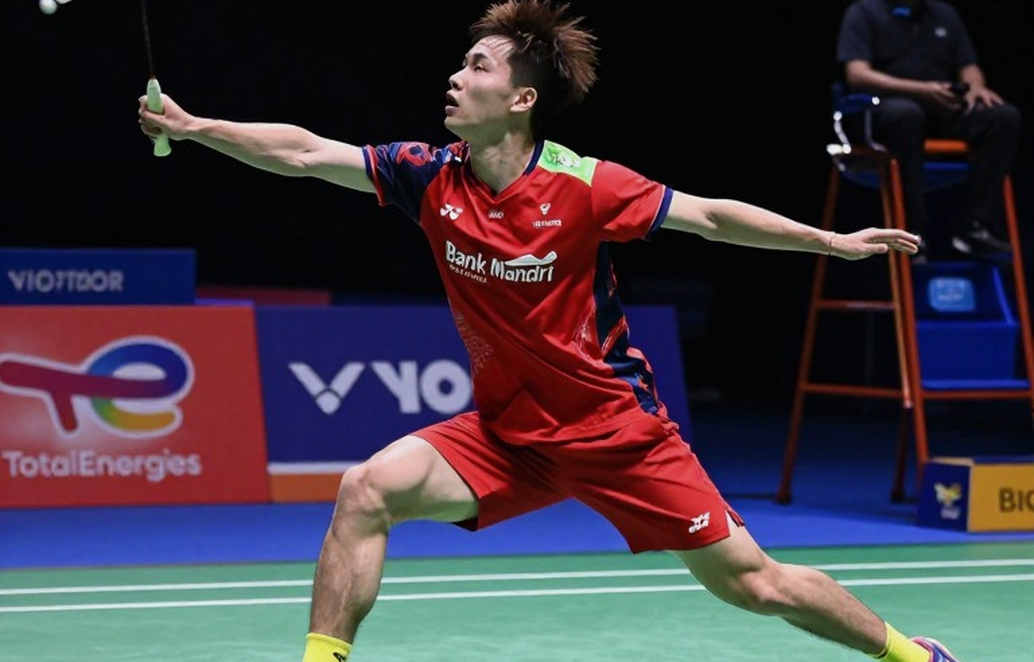
The top half of men's singles is a structural trap. When two attacking players with pedigree are locked into the same narrow section, the value of the draw inverts: instead of opening a path, it closes the door early for one half of the opportunity. Lakshya Sen plays all-court badminton built on tempo changes and deceptive slices. Loh Kean Yew plays the opposite — speed, endurance, and relentless pressure across the first three shots. When these styles meet in round two, the match is largely decided at the net and in the quality of the first serve. If Loh drags the tempo up continuously, Sen will burn more energy than he wants on day one — and the following day is the round of 32 plus the round of 16. The gap here is not on the court. It is in the calendar.
The women's singles half has a very different structure: difficulty rising in steps. PV Sindhu, if she follows the expected path, meets Letshanaa Karupathevan of Malaysia, then Tomoka Miyazaki of Japan, then possibly Chen Yufei of China. Three opponents, three styles, three different energy costs. Letshanaa is an entry test. Miyazaki, in her early twenties, is rising, fast and persistent. Chen Yufei sits at the other end of the spectrum — a rally controller who stretches every point and forces opponents into error. For a power attacker like Sindhu, Chen Yufei is an unfavourable endpoint if games stretch beyond the fifteen-point mark. When I rewatched footage of their past meetings, that gap was already there, and it was not technical. It lay in the number of rallies a power player can sustain before a control player starts buying time.
In the lower women's singles half, Unnati Hooda meets Song Yu Mi of North Korea. This is the hardest match in the whole draw to analyse, because North Korea is a low-frequency participant that leaves almost no recent international data. No head-to-head, no video, no metrics. An unseeded player nobody knows how to read is a variable that muddies the path of any nearby seed. Data does not lie, but it does not play badminton either.
In the lower men's singles half, Ayush Shetty could meet Chou Tien Chen of Chinese Taipei. This is a notable generational collision: Shetty at the start of his international career, Chou at the close of a long one. Chou no longer has peak speed, but he reads a match better than almost anyone of his generation and knows how to turn a young opponent into a patience exercise. For Shetty, the question is not whether he hits harder, but whether he can endure a slow game that has been deliberately arranged.
Men's doubles is the most densely concentrated region on the continent, and this draw reflects that tradition. Satwik and Chirag, on the expected path, could meet Kim Won-ho and Seo Seung-jae of Korea in the semifinal. This section also holds Fajar Alfian and M. S. Fikri of Indonesia, plus the Thai pair Peeratchai Sukphun and Pakkapon Teeraratsakul. This is the kind of section where return-of-serve quality and mid-court control decide, not raw power. At this level, who smashes harder has almost ceased to be the question. Who keeps the shuttle lower on the third shot is the question.
Women's doubles and mixed doubles also feature Indian entries in Gayatri Gopichand with Treesa Jolly, Kavipriya Selvam with Simran Singhi, and on the Indonesian side Febriana Kusuma with Meilysa Puspita Sari. These pairs sit at different development stages, and their shared presence in one draw says something about selection systems: India is using the Asian Games partly as a transition pathway, not purely as a medal hunt.
Now the contrarian part, the one I consider most important and least discussed.
A draw is not a prediction. This is what most reports quietly blur when they use the phrase "could meet" for each round. A draw is only a set of conditional possibilities, and each condition depends on a match not yet played. When you read a report saying Sindhu "could meet Chen Yufei in the quarterfinal", you are reading a sentence with at least four hidden conditional clauses. The only correct reading is to treat each round as an independent match, then sum the probabilities.
The second blind spot lies in two pairs named in the original report. Fajar Alfian is listed with M. S. Fikri, while his familiar partner is Muhammad Rian Ardianto. Seo Seung-jae is listed with Kim Won-ho, while his established men's partner is Kang Min-hyuk. There are two possibilities: these are experimental pairings for a multi-sport event, or they are reporting errors. Both possibilities lead to the same practical conclusion — every projection about the men's doubles section must be re-checked against the official entry list before being trusted.
The third blind spot belongs to the source. The original report came from a generalist sports site, not a badminton specialist, and its closing block is a social-media self-promotion module. That does not make the information false, but it lowers the confidence level until triple verification is done. I verified the schedule, the dates, and the byes; the pairings remain open.
Finally, there is a question this tournament raises but does not answer. Does the Asian Games carry BWF ranking points, and if so, at what level? This is not academic. It completely changes how results are read: a player might accept risk here for medal value, or avoid risk for fear of losing points. Until official documents arrive from the continental federation and the Olympic Council of Asia, every conclusion about ranking consequences is speculation.
A crisis in badminton does not begin with a shuttle sailing out on match point. It begins on the morning of September 25, when a player walks onto court with legs not yet recovered and a second-round match he knows will cost twice the usual energy. The gap is there, in the schedule, not in the technique. And I will verify it on September 26, when the same person must play two matches in one day, at a tournament that comes only once every four years.
Cầu thủ liên quan
Bài đề xuất
Indian Badminton Squad at Asian Games 2026: Between Expectation and Challenge2026-09-11
Asian Games 2026: The Stamina Variable and the Depth Equation Behind India's 1-3 Women's Team Loss to Japan2026-09-24
Asian Games 2026: India's Badminton Contingent and the Gamble on One Pair2026-09-12
Satwik-Chirag make history: Indian duo wins first China Masters title after stunning comeback2026-09-11
Ashmita Chaliha Questions BWF: When Home Court Is No Longer an Advantage, Standards Must Be One2026-09-03
Nguyễn Tiến Minh Wins a Qualifier at 43: Reading a Victory With Missing Data2026-09-15
Ashmita Chaliha and the Double Standard Question: When Super 100 Is Forgotten2026-09-04
Bài đề xuất
Vietnam Badminton Transfer Window 2026: A Data Filter in a Summer Full of Noise2026-09-11
Badminton at Seoul 2026: The Demonstration That Opened the Road to Barcelona2026-09-16
Asian Games 2026: India's Women's Team and the Depth Equation — The Quarter-Final Exit Was Not Decided by the 6-21 Game2026-09-23
China Masters 2026: Satwik – Chirag and the Five Final Points That Closed the Gap2026-09-12
Srikanth at 33: The Win Over Victor Lai and the Question of Resurgence2026-09-04
Asian Games 2026: India's Badminton Medal Path and the Host-Nation Bottleneck2026-09-21
India's Badminton Squad at the 2026 Asian Games: 20 Shuttlers, One Anchor, and an Age Equation2026-09-16